For decades, the name Ducati has been synonymous with high-performance racing, heart-stopping design, and that signature, visceral thunder of a desmodromic L-twin. The Bolognese brand is more than just a motorcycle manufacturer; it’s an Italian icon that has repeatedly pushed the boundaries of speed and style.
The Ducati company was founded in Bologna in 1926 by the three Ducati brothers as Società Scientifica Radio Brevetti Ducati, initially excelling in the manufacture of radio components. Following the destruction of their factory during World War II, Ducati pivoted to motor vehicle production to meet Italy’s post-war transport needs. This transition began in 1946 with the massively successful “Cucciolo,” a small clip-on engine for bicycles, which paved the way for their first complete motorcycle, the Ducati 60, in 1949. The arrival of engineer Fabio Taglioni in 1954 was pivotal, leading to the development of the revolutionary desmodromic valve system (Desmo), a key technology that has defined Ducati’s high-performance, high-revving racing engines ever since.
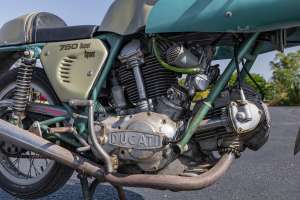
Ducati further solidified its identity with the introduction of the 90° V-twin engine layout, known as the L-twin, which gained racing fame with a victory at the 1972 Imola 200 and led to the iconic 750 Super Sport. The modern era was marked by two significant models: the 1993 Monster, a bestselling “naked” street bike, and the game-changing 1994 916 Superbike, which dominated the World Superbike championship and influenced motorcycle design globally. Now owned by Audi AG since 2012, Ducati continues its legacy of technological innovation and racing excellence in championships like WSBK and MotoGP with advanced engines such as the Desmosedici V4.
At Bike EXIF, we’ve had the pleasure of featuring countless custom machines, but the ones built around a Ducati engine always carry a certain mystique—a challenge to tame and refine an already ferocious beast. While the stock bikes are works of art, the real magic happens when world-class builders get their hands on that Italian firepower. Here are eight of our all-time favorite custom Ducatis featured on Bike EXIF.
Rough Crafts’ Savage Custom Ducati Monster
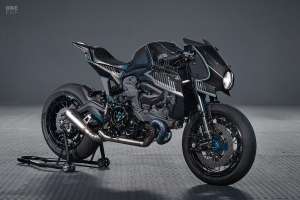
For many enthusiasts, the loss of the iconic trellis frame on the ‘new’ Ducati Monster was a tough pill to swallow. Luckily, Winston Yeh of Taiwan’s Rough Crafts wasn’t deterred. When a client requested an aggressive, performance-focused custom, the powerful yet manageable new-generation Monster rose to the top of his list, offering enough performance while being “simple enough for us to go wild.”
The mission was to perfectly blend retro styling with modern high-tech race elements—a huge challenge on a tightly packed modern machine. Winston ditched the original molded tail section for a gorgeous CNC-machined aluminum subframe from Artitek Ltd., topped with a slim 3D-printed tail cowl. The OEM fuel tank remains, but it’s cloaked in new carbon covers and flanked by 3D-printed ‘wings,’ all finished in signature Rough Crafts black with kinetic graphics and subtle blue accents. The details are luxe, from the hand-crafted tank badges by 2 Abnormal Sides to the exquisite seat upholstery.
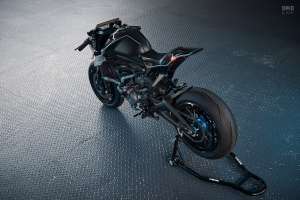
The Monster’s overhaul goes far beyond cosmetics, however. It features blacked-out Öhlins FGR300 forks up front, held by a CNC Racing bottom yoke and a Rough Crafts top yoke. The rear utilizes an Öhlins shock from a Monster SP. Winston went all-out on the running gear, fitting Jonich laced wheels wrapped in Pirelli Supercorsa V4 tires and swapping the calipers for Brembo 484 units with SICOM carbon-ceramic discs all around. Finished with a plethora of CNC Racing parts, carbon fiber trim, and an SC-Project can on Zinja Handmade titanium headers, this custom Monster is a menacing testament to modern street performance. [MORE]
Ducati Scrambler Flat Tracker by Samy Garage and Greaser Garage
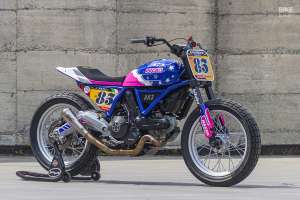
Paint is usually the last step, but the livery on this race-ready Ducati Scrambler flat tracker is what makes it unmissable. Built as the personal race bike for flat track racer Sami Panseri of Samy Garage, the aesthetics were handled by Genoa’s Greaser Garage, who were given free rein to create a chaotic-but-considered paint scheme in blue, magenta, and reflective silver.
The livery is an homage to flat track racing’s US heritage, featuring 70s-style checkers, chrome stars, and stylized wings on the tank sides referencing the old Ducati logo. But beneath the eye-popping graphics is a serious race machine based on the basic 803 model. Sami fitted new wheels using stock hubs and 19” Desert Sled front rims wrapped in Maxxis dirt track tires, going so far as to modify the swingarm for clearance to avoid extending the wheelbase. The front brake was, obviously, removed.
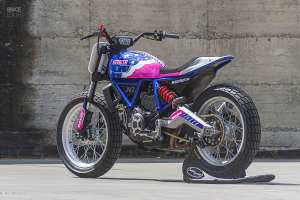
Performance upgrades include a Bitubo fork cartridge kit and rear shock, a modified frame with removed steering stops for maximum slide-ability, and a cut-and-looped tail. The bodywork consists of the stock fuel tank and a replica Bultaco Astro tailpiece. The L-twin motor’s output is boosted with a Starace intake kit and a new ECU map, venting through custom oversized headers mated to an SC Project muffler. Built to be visible even through the track dust, this zany Scrambler is ready to tear up the Hooligan class. [MORE]
Ducati Monster 600 Cafe Racer
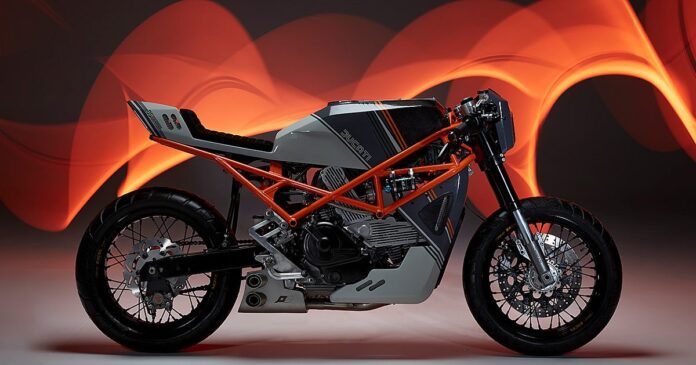
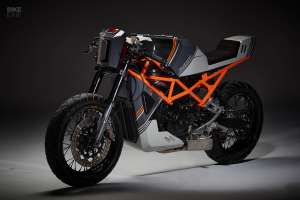
The definition of a café racer is consistently evolving, moving from 70s Hondas and BMW airheads to modern machines that blur the lines between retro and contemporary. This slick 1994 Ducati Monster 600, nicknamed ‘Ghost’ and built by Manchester-based designer Antony Ruggiero of For The Bold, perfectly typifies this shift. Antony set out to challenge himself by turning his own Monster into a “retro yet modern version” of a café racer, spotlighting the iconic trellis frame.
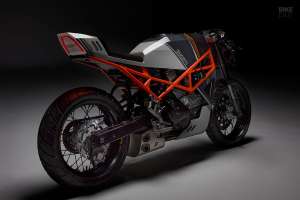
Using traditional techniques like clay modeling and modern materials like carbon fiber, Antony crafted angular, ultra-lightweight bodywork, including an extended tank that sits lower and closer to the air filter for a sportier riding position. The wheels are a unique blend of Yamaha XS650 hubs and custom-drilled Excel rims wrapped in aggressive Avon Trailriders. The rear subframe was shortened, and a TFX mono-shock with an external reservoir was neatly tucked away.
The engine breathes through an unusual QD Ex-Box exhaust system—a low-slung unit that conceals tuned acoustic chambers. Functionality is blended with form through extensive 3D design: printed plastic parts form the fairing vents and lower bodywork, while 3D files were used to CNC-cut aluminum for the tail unit, triple tree, and cam belt covers. With its neutral color palette and visual balance, Antony’s Monster 600 proves that modern angles and the classic café ethos can indeed coexist beautifully. [MORE]
Ducati XDiavel S from MFix Workshop
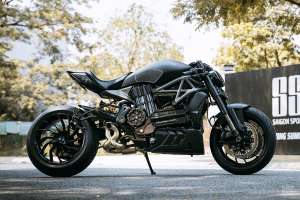
The Ducati XDiavel S—the audacious offspring of a superbike and a cruiser was the starting point for a client at Vietnam’s MFix Workshop who was inspired by Ducati’s wild draXter concept. The goal was to imbue the XDiavel with a similar aggressive vibe, culminating in a machine that significantly altered the bike’s stance and ergonomics.
MFix started by radically changing the ride height, fitting an Öhlins rear shock from a Kawasaki ZX-10R, and creating a CNC-machined swingarm linkage to accommodate it. In what may be one of the biggest relocation jobs ever, the forward foot pegs were moved all the way back alongside the rear wheel, necessitating the custom-machining of all foot controls and brackets. The stock riser bars were swapped for low-slung clip-ons, held in place by a burly billet aluminum top yoke.
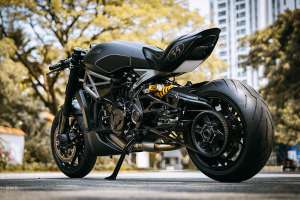
The bike is a testament to meticulous detail, featuring ISR controls, fresh Brembo calipers, and a rattling CNC Racing dry clutch. A full quiver of Fullsix carbon fiber parts adorns the body. But the most striking element is the custom, curvy pie-cut titanium exhaust system that snakes its way through the XDiavel, exiting just in front of the rear wheel. The final, ironic touch? Custom-machined aluminum engine covers—prototyped over four months—that make the L-twin look like a muscular Harley-Davidson V-Rod engine, topped off with a V-Rod headlight. [MORE]
VTOPIA’s Kinetic Vision for the Ducati Diavel V4
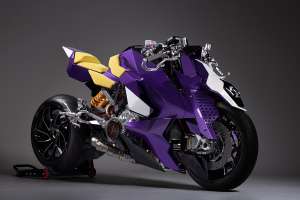
The Ducati Diavel is already a brutal, unconventional machine—a cruiser with a superbike’s soul. But leave it to VTOPIA Design to make the stock Diavel look tame. Known for their work on the Vyrus range, VTOPIA took their angular, frenetic geometric aesthetic to the extreme, turning the Diavel V4 into a futuristic, sci-fi sculpture they dubbed ‘Anima.’
VTOPIA lead designer Giorgio Cerrato channeled his background in architecture, 3D modeling, and even the futuristic anti-gravity racing game Wipeout to create this sensory overload. The Diavel V4’s original bodywork was replaced with a full set of angular, layered carbon fiber fairings finished in bright purple—a kinetic sculpture that looks animated even at a standstill. The dedication to this design language extends to the seven-part Alcantara and neoprene seat, and the intricate, CNC-machined aluminum and 3D-printed nylon brackets that hold the assembly in place.
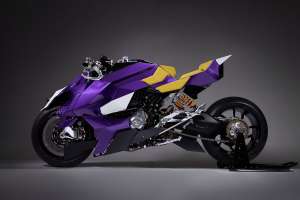
Beyond the bold aesthetics, the build is packed with performance hardware. The front brake uses Brembo GP4-MS calipers with carbon-ceramic discs, cooled by Motocorse fork bottoms and air ducts. An STM x Ducati Performance dry clutch cover and a full set of Motocorse crankcases adorn the engine. The rear subframe is a new CNC-machined unit supporting an Öhlins shock. Finally, a titanium four-into-four exhaust system fabricated by Spark ensures the Diavel sounds as brutal as it looks. VTOPIA plans an exclusive run of just five of these provocative, experimental machines. [MORE]
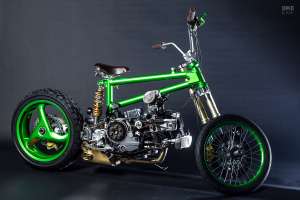
A BMX-Style Motorcycle with a Ducati Engine by Balamutti Workshop
If there’s one build that truly embraces the “build whatever you want” philosophy, it’s Balamutti Workshop’s chaotic, custom BMX-style motorcycle named ‘Malavita’ (Underworld). Built around a heavily modified Ducati Pantah engine, this three-year project is a complex mish-mash of parts and repurposed components designed for a “relaxing ride” with an “unobtrusive appearance”—claims that are deliciously ironic given the result.
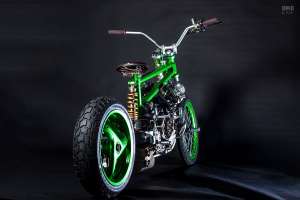
The Pantah engine was taken to the extreme: the vertical cylinder was removed, and the remaining cylinder was over-bored, converting the L-twin into a 426 cc single. The trapezoidal frame is BMX-inspired, holding the engine on small mounts. Arguably, the most staggering feature is the in-house designed and fabricated one-sided dual-fork setup using Marzocchi components. The rear uses a single-sided swingarm from a Hypermotard 1100, hooked up to a Penske mono-shock. The minimalist aesthetic is completed by in-house bars and a 70-year-old Brooks bicycle seat.
The absurdity reaches its peak with the fuel system. The filler cap and tap are not for gas, but for fine Scottish malt whisky—turning the bike into a rolling Scotch dispenser. The actual fuel is held in a custom-made 7-liter tank hidden inside the boxy, dual-exit muffler (which is a fake, with the real exhaust exiting just in front). Malavita is a fun-fueled exercise in engineering audacity that throws convention out the window. [MORE]
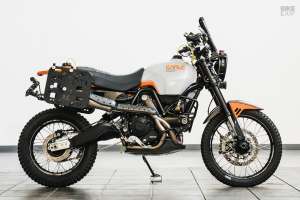
Earle Motors Ducati ‘Alaskan’
Most customs are garage queens, but Alex Earle’s Ducati Desert Sled conversion, named ‘The Alaskan,’ was designed and built specifically to be thrashed for two weeks across Alaska’s toughest terrain. As a designer at VW America, Alex’s concept was inspired by true adventure—machines that tackle inhospitable places.
The Alaskan is a “middleweight ADV bike with all the necessities and none of the frills.” It’s based on a 2017 Desert Sled selected for its simple air-cooled 803 cc L-twin and strengthened frame. The motor is geared down by about 10% (14F/48R sprockets) for better low-speed control, and the swingarm has been lengthened by almost three inches to 62″ for high-speed dirt stability. The wheels are ultra-strong Excel A60s, with the front boosted to 21 inches—critical for cutting through sand and mud.
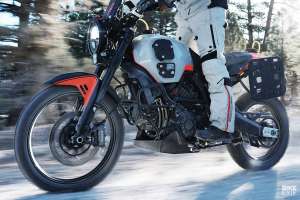
The biggest functional change is the bodywork, which features a hand-formed six-gallon main fuel tank, supplemented by an extra two gallons in the tail unit, nearly doubling the stock capacity. The bike also sports a NASA-themed logo, heavy-duty crash bars, a bulletproof Kevlar skid plate, and a Scotts Performance steering stabilizer. After its torturous journey, Alex reported the bike exceeded expectations in deep river crossings, mud, and snow. The Alaskan proves that a custom Ducati can be a rugged, cross-continent expedition machine. [MORE]
Ducati GT1000 by Purpose Built Moto
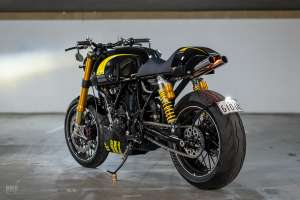
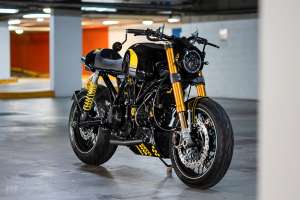
The Ducati SportClassic GT1000 is often overlooked next to its flashier siblings, but as the founder of Australia’s Purpose Built Moto (PBM), Tom Gilroy, knows, it shares the same excellent bones: a 992 cc desmodromic L-twin and a trellis frame. Tasked with modernizing the GT1000 without losing its distinct tank, PBM created a lighter, tighter, and better-equipped custom.
PBM immediately sorted the suspension, swapping the forks for the Öhlins setup from a Ducati Monster 1200R and installing a pair of GT1000-specific Öhlins rear shocks. The heavy steel rims were replaced with exotic Jonich M9 hoops—carbon-wrapped aluminum rims that offer a tangible weight difference and are wrapped in Pirelli Diablo Rosso IV rubber.
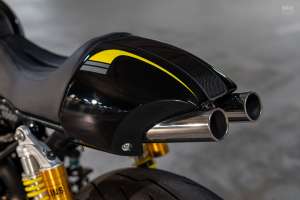
The subframe was trimmed back to allow PBM to execute the client’s key request: an under-tail exhaust system. Tom designed a two-into-one-into-two system where the collector passes through the gap in the swingarm before splitting into twin mufflers that hug the tail. A new sheet metal tail cowl was shaped to complement the OEM tank, picking up its design cues. Finished in a striking black and yellow livery, the PBM GT1000 is an exquisite blend of retro charm and modern café racer performance, showing the true potential of the SportClassic platform. [MORE]