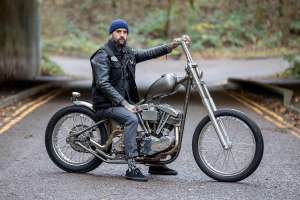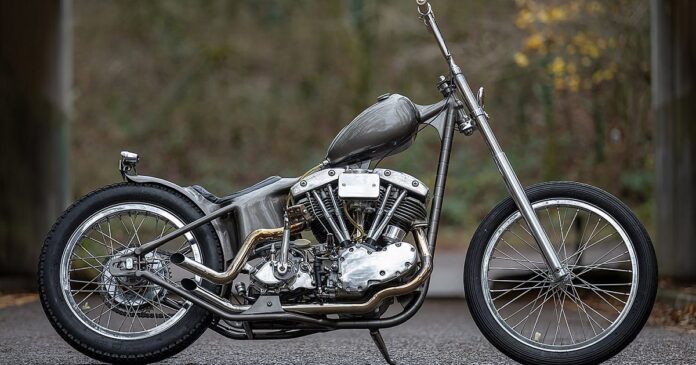
Full-time tattoo artist and part-time chopper builder Chris Hatton wows with a Harley Shovelhead chopper featuring a handmade frame and molded bodywork.
Each new year puts the notorious COVID-19 pandemic further in the rear-view. But while it was a dark time for most, the mundanity of the global lockdown motivated some people to explore their creativity. Thus, a new type of custom motorcycle project emerged: the ‘lockdown build.’
This impossibly skinny Harley Shovelhead chopper was Chris Hatton’s lockdown build. And although he buttoned it up almost five years ago, it’s still a knockout.
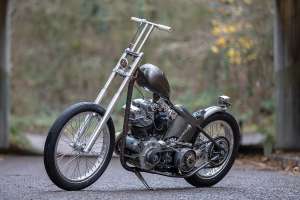
Based in Risca, Wales, Chris’s upbringing was a mixed bag of BMX, motocross, and taking bikes apart in the hope that they’d still function after reassembly. Multiple injuries eventually drove him away from motocross and ignited an interest in choppers, alongside an engineering apprenticeship that would build on the skills he acquired while maintaining his race bikes. But fate had other plans.
Chris eventually abandoned the apprenticeship to pursue his other passion: tattooing. He dedicated most of his time to his new studio, Physical Graffiti in Cardiff, but the desire to build custom choppers never quite waned. So he spent his days off working for free at Trike Design in nearby Caerphilly, where he made tea, swept the floors, and absorbed as much knowledge as he could.
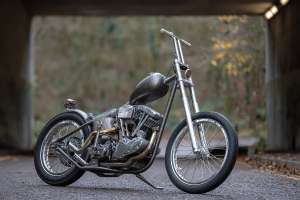
Before long, Chris had the confidence to start building his own bikes. Plus, he had Robin Davies at Trike Design and Ian Marshall at Marshall Speed and Custom in Newport on speed dial if he needed help. His side hustle blossomed—when Chris wasn’t tattooing, he was churning out custom builds and parts under the banner of Left Hand Choppers.
Chris had several choppers under his belt by the time the pandemic hit, including a 1967 Harley-Davidson Shovelhead that he’d taken to myriad rallies and shows. Unable to run his tattoo shop during the UK’s lockdown, he looked at the Shovel and figured he could do better.
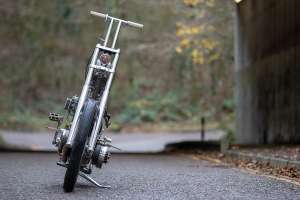
“This project was the result of my overactive mind,” Chris explains. “I wasn’t happy with the bike in its previous form, and after many months procrastinating over what I’d do differently if I had the chance to do it all again, I thought ‘fuck it,’ tore the bike apart, and started again.”
According to our friend and ace photographer Del Hickey, much of Chris’s inspiration came from the Japanese chopper scene. A vision began to form of a skinny, tall bike with a bespoke single down tube frame, a clean front end, one brake, and minimal controls and wiring. Chris’ lockdown build was officially underway.
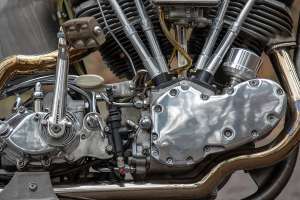
One advantage of starting with an already-complete motorcycle was that Chris had already rebuilt the engine. The early-model generator Shovel motor was equipped with a Mallory electronic ignition, a Cycle Electric Inc. charging system, and an open belt primary drive from Belt Drives, Ltd. The breadbox air cleaner came from Trident Cycle Supply, and the serpentine stainless steel exhausts were hand-made by Chris.
With the motor raring to go, Chris got to work fabricating a custom hardtail frame around an Arch Engineering headstock. “I made a single loop frame with a few extra details on the neck and down tube, to add something a little different to this chopper,” he says. “5” up, 0′ out, and a 24-degree rake made it a tall and short bike with pretty legit cornering abilities.”
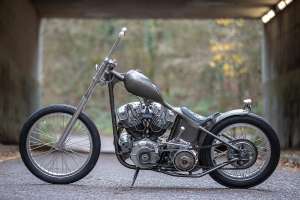
For the running gear, Chris started with 6-inch over forks and yokes from Visionary Cycle Products. He smoothed the yokes and had them chromed before fabricating a set of narrow and tall T bars.
Viewed squarely from the side, the forks and the bars trace a flawless line, from the vintage H-D grips at the top to the brakeless front hub below. A tiny LED headlight from FnA Custom Cycles floats between the yokes, while the cockpit features nothing more than a throttle, its cable routed neatly through a custom-made guide welded to the bars.
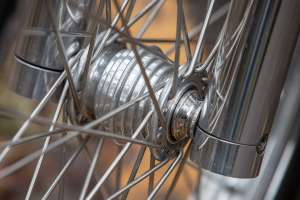
The Shovelhead’s wheelset is equally well judged. A 21” Morad rim sits up front, laced to a spool hub. The rear wheel uses a 19” Morad rim and a hydraulic drum brake hub, hooked up to a Brembo master cylinder that was lifted from a sportbike.
It’s a super-sano setup, made more impressive by the custom foot control setup that Chris put together. Mounted high and tight, the arrangement features a foot clutch and a heel-operated brake pedal, along with custom linkages and Charlie Hagan pegs. A gleaming hand-shifter pokes out from just above the open primary.
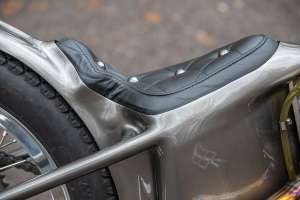
With time on his hands, Chris was motivated to push himself on this project. So when it came time to add new bodywork to the mix, he pulled out all the stops.
“I went for a fully molded tank and frame,” he tells us. “Using a Wassell fuel tank, I cut it up and mounted it around the top tube. Then, on the one-off oil tank, I wrapped it from the seat post tube around the fender, leaving the cross frame brace exposed. This was the biggest headache of the whole build.”
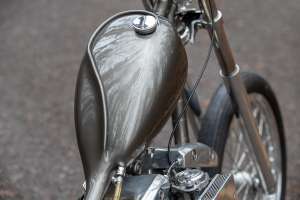
Extra details include a curved ridge along the top of the tank, a petite gas cap, and a skinny seat sporting leather and domed studs. “The rear uses a Lowbrow ribbed fender that I narrowed by an inch,” Chris adds. “I added a flick at the rear to hold an old Lucas twin tail light [now equipped with LED internals], which was gifted to me by a good friend, Ian Marshall.”
Making everything flow seamlessly meant that Chris had to do a ton of work under the hood. The oil tank hides the oil filter, plus a sealed tube with wiring routed through it. Between that mod and the scratch-built wiring loom, there’s hardly any visible wiring on the bike.
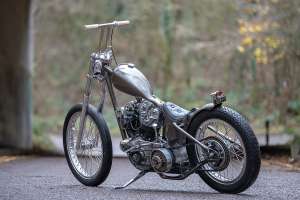
Looking to amp up the Shovelhead’s minimalist vibe with an equally simple paint job, Chris chose to paint the frame and bodywork in Mercedes-Benz’s Indium Grey Metallic. The combination of the molded bodywork’s stormy hue and the stark lines of the chassis is intoxicating.
Chris is clearly happy with this second iteration of his 1967 Harley Shovelhead—he’s had it for a few years now, and hasn’t changed a thing.
Left Hand Choppers | Chris Hatton Instagram | Images by, and with our endless gratitude to, Del Hickey
Chris would like to thank Ian Marshall of Marshall Speed and Custom, Robin Davies, Matt Engineering, Lee Carter for the paint, Nick at Celtic Motorhomes for the seat upholstery, and last, but by no means least, a huge thanks to my girl Sami for all the encouragement and support.