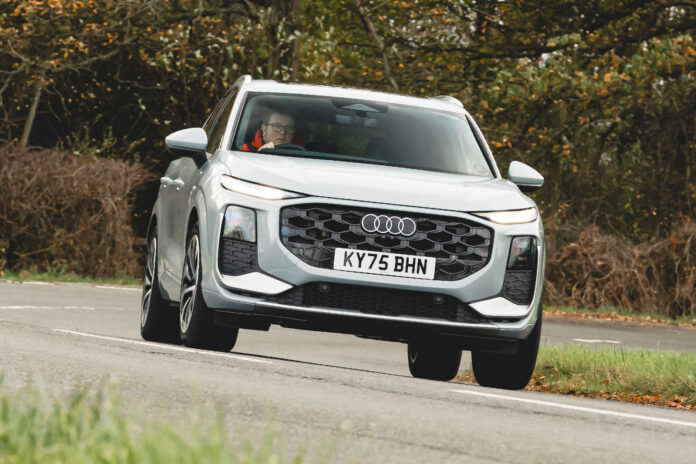
The Q3’s roofline is lower than on some cars in its class – and so, in terms of both length and width, it continues to present a slightly more elfin take on the premium small SUV concept, trading on big-car space and character in a compact, manageable package.
It gives up a little passenger space relative to some rivals as a result of that positioning, but not much. In the front row, there’s plenty of outright leg room, some fine, adjustable, supportive seats and 990mm of head room. In the back—where you might be surprised to find that sliding seats come as standard—leg room can be extended to 680mm. A BMW X1 has 7% more front-row head room and 10% more second-row leg room; a Volkswagen Tiguan has more space back there still.
So, despite its growth, this car still comes with a bit of a practicality compromise, though it may not be a very relevant one. With Isofix child-seat anchorages fitted on the front passenger seat as well as the outer rear ones, it’s younger families being targeted here, as well as drivers who appreciate a car that’s both wieldier and easier to park than some rivals. As if to prove as much, boot space is more competitive than before: about level with the X1 on seats-up loading length and more generous on outright width.
The Q3 does away with traditional indicator stalks and light switches. It instead deploys a single control unit behind the steering wheel for the indicators, wipers and lights.
The indicators are controlled via switches that you flick up or pull down. The windscreen wipers are on a click wheel. The lights are on buttons. It feels a touch clumsy at first, but it would become second nature before long. Whether you think you should have to learn new ways of doing things that have worked perfectly well for decades is another matter.
The S Line trim of our test car brought with it plenty of quite plush-looking Dinamica suede on the door panels and dashboard. Leather trim padding elsewhere also lifts the ambience – only for Audi’s now-familiar smudgy piano black plastic trim to knock it down here and there.
Some quite subtle ambient lighting has a positive effect, but ultimately the verdict here is mixed: the cabin is quite hefty-, pudgy- and expensive-feeling in some places, but cheaper and scratchier in others, and the perceived quality is not quite consistent enough to lift the Q3 above its competitors.
Multimedia
The Q3’s 12.8in multimedia system is tacked onto the side of the same console as the digital instruments, and presented as if it were one installation—as is becoming increasingly common. It’s set quite high and far back on the fascia, so it can be a bit of a stretch for your left arm, but there’s plenty of space around its periphery to anchor a finger while you’re prodding and swiping, as you inevitably have to do without any physical input device to scroll a cursor around with.
Below the main screen, a row of physical buttons allows you to directly change the drive modes or deactivate the ADAS functions, and there’s a volume/on-off knob for the stereo. Heater controls are on the screen itself, permanently displayed across its base, which isn’t ideal but works acceptably well. A right-hand nav bar and top-margin shortcut row between them make usability and general navigation quite easy.
The Android-based system is crisp and responsive, and established a reliable wireless smartphone-mirroring connection with an Apple phone for us without a problem.