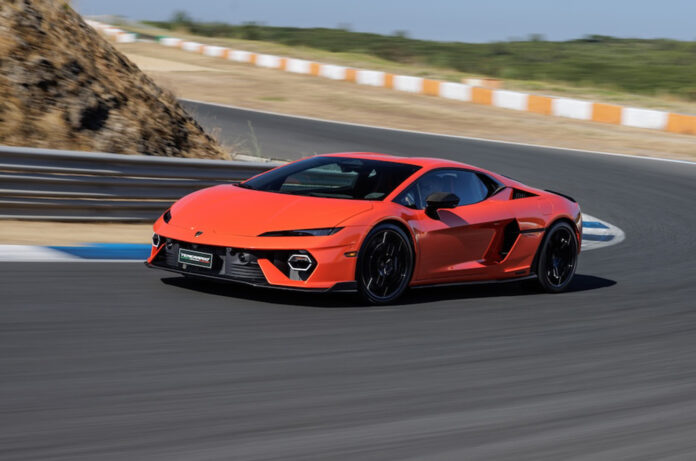
The driving position in the Huracán at times felt like a relic from Italian supercars of the ’70s. The header rail was so low-flying that you couldn’t pull right up to traffic lights, lest you hinder your view of them. The driving position was oddly perched too – on top of the jet fighter canopy, not within it.
The Temerario is much better in these respects without losing too much of the extraterrestrial ‘wow’ factor when you first drop aboard. It helps that the wheelbase is 40mm longer than the Huracán’s, but that alone doesn’t explain the full extent of the ergonomic improvements.
There has quite obviously been a reconsidering of the mounting for the seats, and the positioning of other architectural elements. Your hip point still feels higher than it might in an Artura or 911, but the driver is now more intuitively positioned relative to the dashboard and the arc of the severely raked windscreen. As a consequence, you instantly have more confidence when it comes to simply operating the Temerario. Visibility is also good by supercar standards, with large quarterlights. This is handy, given the car will demolish the quarter-mile dash in 10.0sec dead.
The Temerario’s ability to do the basics neatly extends to the switchgear. All the important commands are given dedicated buttons and the dials, materials and weighting have a whiff of Audi’s glory days of the late 2010s. Only the awkward placement of the indicator controls on the left-hand steering wheel pad will irk (presumably a stalk was thought to get in the way of the vast gearshift paddles?), though you soon get used to this.
The other side of this coin is that in putting all the meaningful controls on the steering wheel (those that control the dampers, powertrain, optional nose-lifter, headlights, lane keep assist and, on the back side, the infotainment commands), Lamborghini has made the Temerario exceedingly easy to operate on the fly. Which is just as well, because the central touchscreen is still no great pleasure to use.
From an aesthetic perspective, the cabin of our test car is on the spartan side, with dark Alcantara and a lot of optional carbon beyond what the Alleggerita package brings. You can go for something a lot warmer and flamboyant, particularly if you make use of Lamborghini’s Ad Personam atelier. Full-leather interiors of green, tan and even turquoise are available.
So too is a Sonus Faber sound system that does a decent job of cutting through class-typical road roar. Another interesting option is the Vision pack, which features a trio of 4K cameras, integrated into a telemetry-gathering feature similar to Porsche’s Track Precision app.
It would be no trouble at all to configure a Temerario with a greater sense of occasion than our test car. Any visual flair would be combined with a fair degree of comfort (rising further if you stuck with the standard Comfort seats, which can be heated and ventilated) and very high perceived quality.
Only the lack of oddment storage holds the Temerario back as a truly versatile proposition. There is a small net in the rear firewall (optional!) but there are no bins in the door cards and no armrest storage, only a small deck at the front of the centre console with two USB-C ports just ahead. It means that uncorking the car – as you surely will – can turn it into a snow globe of wallets, keys and other loose items. Be warned.
As for carrying capacity, storage is not notably good in any of the current crop of supercars (Maserati MC20 and Chevrolet Corvette Z06 excepted, with their additional compartment behind the engine bay) but there is usually enough for a weekend away. The Temerario is no different in this respect, with 112 litres of storage in the frunk (10% or so more than the Huracán offered but less than the Ferrari 296 GTB or McLaren Artura) and a reasonably broad, usefully flat deck behind the seats that can just about take a couple of squished duffel bags without eating into the car’s reasonably good rear visibility.

